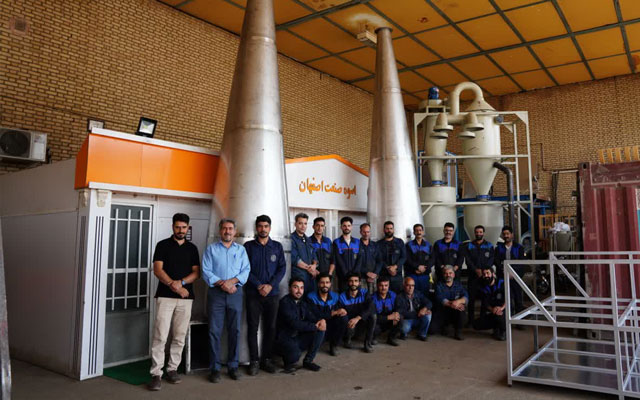



A spray dryer is a device that transforms liquid solutions, suspensions, and emulsions into powder. Of the wide applications of spray dryers in the food industry, one can refer to instant coffee powder, whey protein, and powdered milk. This technology is broadly applicable to heat-sensitive pharmaceutical products such as tablets, vaccines, vitamins, and algae.
Spray drying developed in the 1870s and early 1900s. The invention of this type of dryer dates back to World War II, when immediate food and drug needs as well as transporting heavy lift items required such technology.
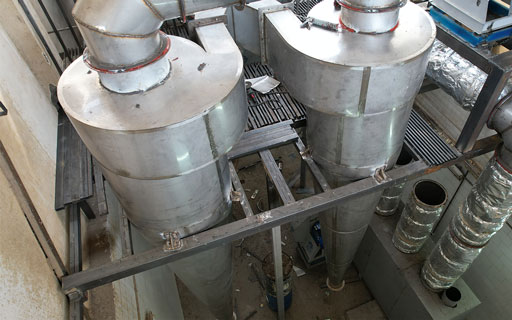
Spray Drying process takes place in 5 steps:
1) Concentration: the liquid feed needs to be concentrated before entering the drying chamber.
2) Atomization: in this step, the liquid feed turns into dispersed droplets, and the opportunity for evaporating the droplets is provided.
3) Droplet-air contact: in the drying chamber, the dispersed droplets are exposed to heated gas, and more than 95% of the liquid content is evaporated.
4) Drying droplets: moisture evaporation takes place in 2 steps: a) in the first step, there is enough moisture in droplets to replace the evaporated liquid; thus, evaporation takes place at a constant rate. b) and the second step occurs when there is not enough moisture to saturate the droplet; hence, what only remains are dried shells.
5) Separation: in order for separation, cyclone and bag filters are utilized. Bag filters or WET scrubbers are used to control air pollution.
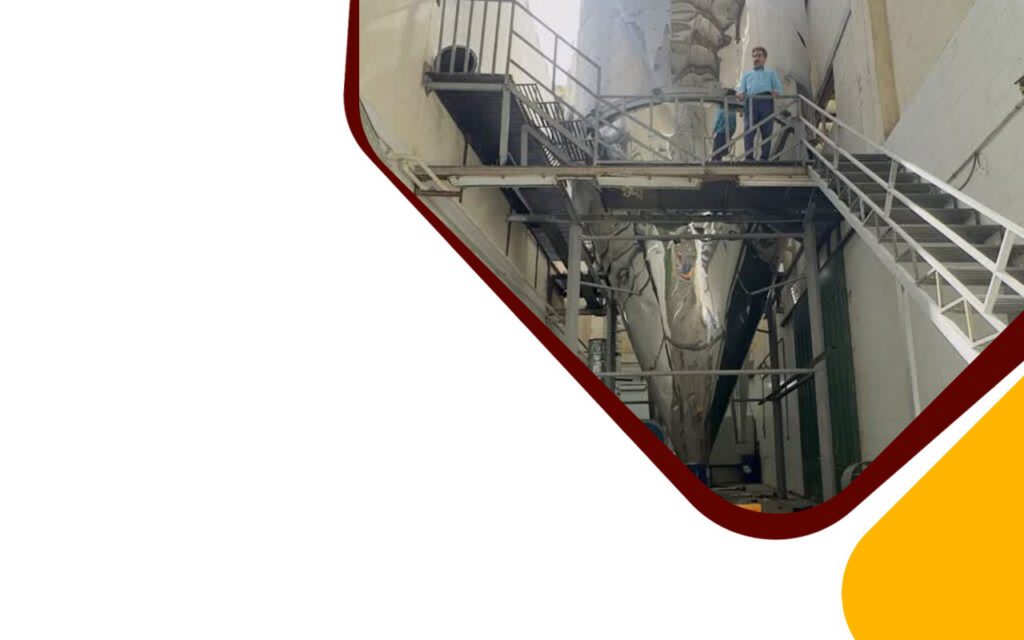
Single-stage vs. two-stage spray dryer
In some spray dryers, the liquid feed is dried at a high temperature during a single process. This type of dryer is called a single-stage spray dryer. The single-stage spray dryer includes a drying chamber, cyclone, and bag filter.
There are spray dryers that can dry at lower temperatures in two stages, provided that the food and pharmaceutical products are heat-sensitive. In the first stage, the liquid feed transforms into powder in the drying chamber and settles on the cyclone. In the second stage, the powder or granule, which is still damp, is dried in a fluid bed dryer.
Fluid Bed Dryer
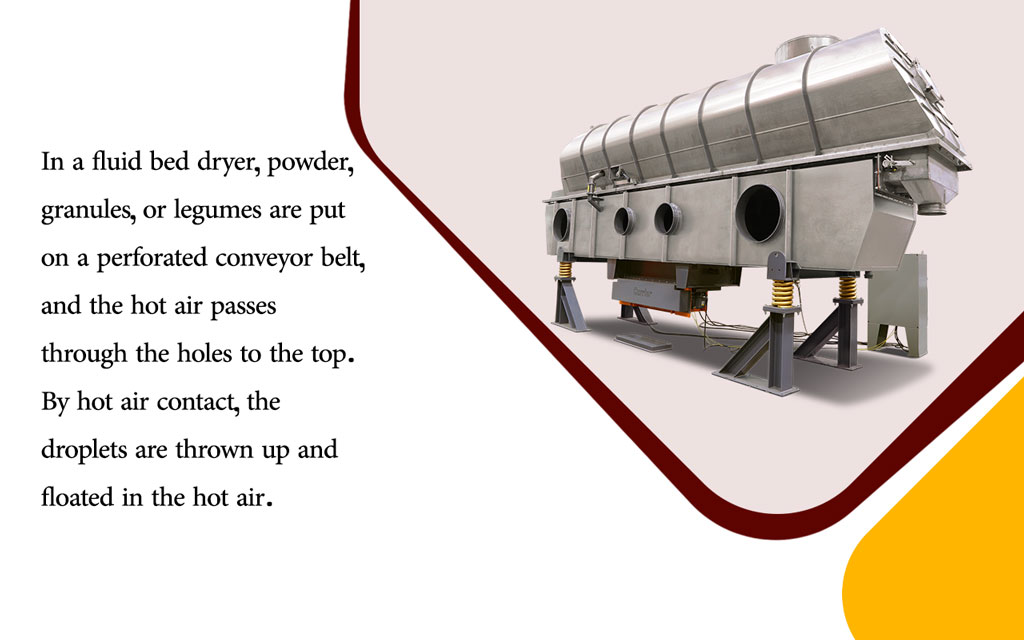
A fluid bed dryer is a complement to other dryers. In a fluid bed dryer, powder, granules, or legumes are put on a perforated conveyor belt, and the hot air passes through the holes to the top. By hot air contact, the droplets are thrown up and floated in the hot air.
Falling Film Evaporator
It is worth noting that the liquid feed must be concentrated before entering the drying chamber. In falling film evaporators, tubes with diameters of 5–25 cm are utilized. The liquid enters from the top and flows to the films by gravity. Falling film evaporators can handle viscous liquids better than rising film evaporators since the liquid flows by gravity. In order to concentrate heat-sensitive liquids such as orange juice, falling film evaporators are used. The typical residence time is about 20–30 seconds in comparison to 3–4 minutes in the rising film evaporators.
Osveh Spray Dryer
We take great pride in informing you that the spray dryer is the latest innovation from Osveh Sanat Company. It has the remarkable ability to convert liquid substances into powder form while preserving their original nutritional properties. Moreover, this dryer can be tailored to meet the specific requirements of our esteemed customers in different sizes. To gain further guidance and a deeper understanding of spray dryers, we encourage you to reach out to our knowledgeable sales team at Osveh.